


The maritime industry was thrown into excitement on Thursday following President Bola Tinubu’s assent to the much-anticipated Nigerian Ports Economic Regulatory Agency (NPERA) Bill on August 12, 2026, transforming it into the NPERA Act, 2026.
The legislation ends decades of the Nigerian Shippers’ Council (NSC) operating as the agency with responsibility for the economic regulation of Nigeria’s port industry.
Consequently, the NSC is being transformed into NPERA, establishing a permanent statutory economic regulator for the nation’s maritime and port sector. However, existing legal and contractual obligations remain valid.

President Tinubu’s assent represents another significant step in Nigeria’s port reform agenda and aligns with the administration’s Renewed Hope Agenda.
The development is also regarded as a milestone for the Minister of Marine and Blue Economy, Dr. Adegboyega Oyetola; the Dr. Pius Akutah-led management of the NSC; and its Board, led by former Katsina State Governor, Dr. Ibrahim Shehu Shema.
The Board, which has provided strategic support to the management and staff of the Council, is also credited by stakeholders with deploying its goodwill, institutional influence and political capital in support of the legislation and its eventual presidential assent.




However, stakeholders who spoke with MMS Plus on the landmark development cautioned that presidential assent alone cannot deliver the anticipated benefits.
They argued that the quality of the regulations, institutional independence, enforcement mechanisms and transition arrangements will ultimately determine the success of the new regime.
Beyond the celebration of what could become a major catalyst for reform in the maritime and port sector, what are the operational implications of the NPERA Act, 2026, for Nigeria’s port ecosystem?
Separation of Port Operations from Economic Regulation
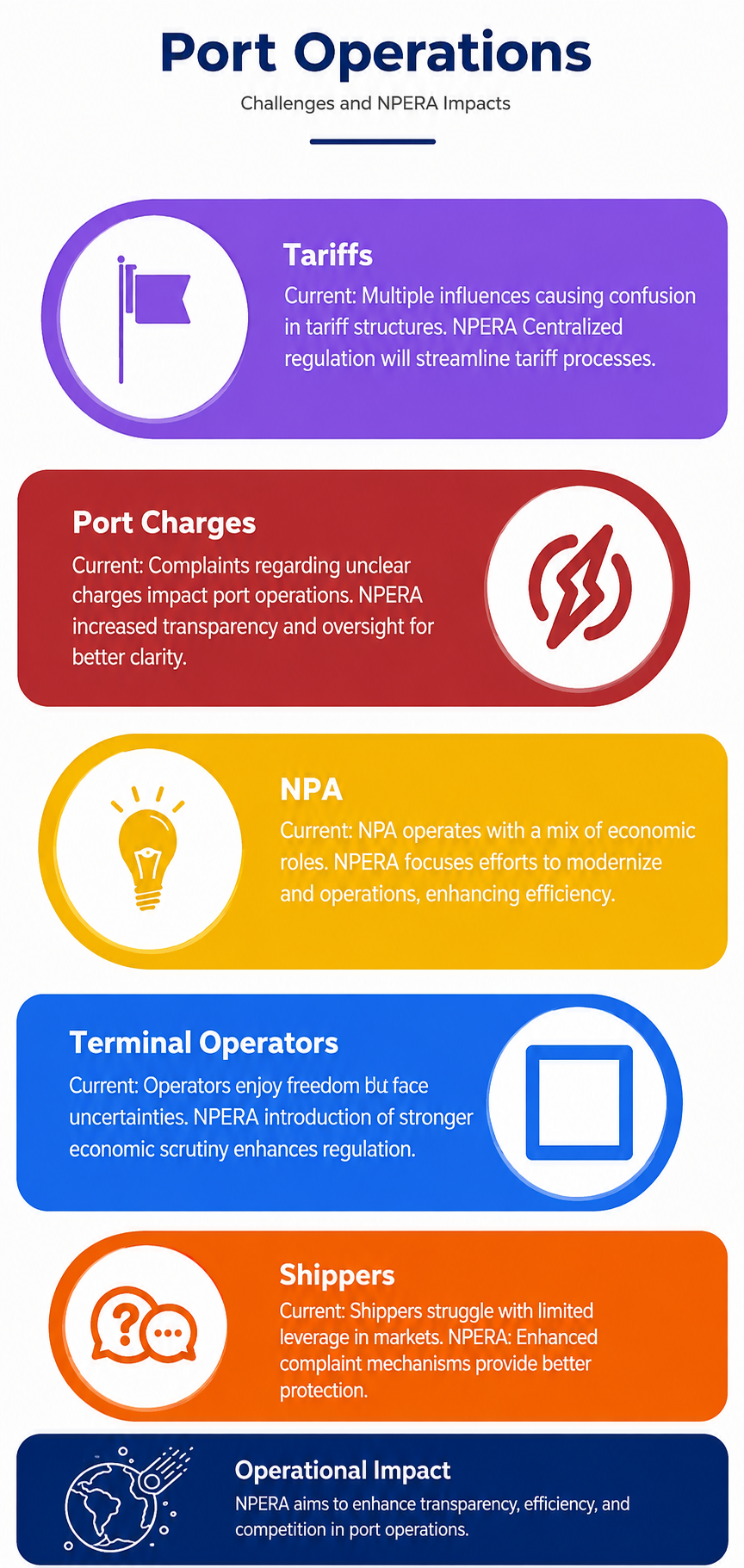
One of the biggest operational changes will be a clearer separation between the Nigerian Ports Authority (NPA), which is responsible for port infrastructure, landlord functions and operations, and an independent economic regulator responsible for commercial regulation.
NPERA is expected to assume responsibility for areas such as tariffs, port-service pricing, competition, licensing and economic disputes, while the NPA retains its core infrastructure and operational responsibilities.
This could mean that the NPA will have less latitude to determine or influence commercial charges, while having greater scope to concentrate on infrastructure development, port modernisation, landlord functions, marine operations and overall efficiency.
Port Tariffs and Charges Could Become More Predictable
The absence of a dedicated statutory economic regulator has often been associated with uncertainty around tariff-setting, commercial charges and disputes.
Under NPERA, tariff regulation should become more structured, transparent and subject to clearly defined regulatory procedures.
For terminal operators, shipping lines, freight forwarders, importers and exporters, this could translate into: Greater transparency in port charges;
stronger justification for tariff increases; improved predictability of port-call costs;
formal mechanisms for challenging disputed charges; and
potentially lower transaction costs.
Terminal and Off-Dock Operators Face Stronger Economic Oversight
Concessionaires, terminal operators and other port service providers should expect more rigorous monitoring of pricing, service quality and competition.
This is particularly important because Nigeria’s port concession model has historically involved private terminal operators operating within publicly controlled port infrastructure.
NPERA would, in effect, introduce a stronger referee into this relationship. The practical question, however, will be whether existing concession agreements are fully aligned with the new regulatory framework.
Operators may therefore need to review their: Concession agreements; tariff provisions;
service-level agreements;
investment obligations;
cost-escalation clauses;
regulatory-change provisions; and dispute-resolution mechanisms.
Greater Accountability for Port Service Providers
NPERA’s economic-regulatory role will not be limited to tariffs. It is also expected to encompass service standards, competition and compliance with established operating procedures.
This could bring greater scrutiny to areas such as: Terminal dwell time; cargo-handling charges;
storage charges;
truck turnaround time;
vessel service charges;
documentation fees;
ancillary maritime services; and
discriminatory treatment of port users.
The operational philosophy could therefore shift from simply asking, “What does the operator charge?” to also asking, “What service does the port user receive for that charge?”
Stronger Protection for Shippers and Cargo Owners
Arguably, this could become one of the biggest potential gains of the NPERA regime.
The new regulatory architecture is intended to provide port users with a stronger institutional mechanism for challenging unfair charges and poor commercial practices, potentially addressing longstanding complaints over excessive or unjustified charges, including container-deposit-related practices.
This is important because port inefficiency ultimately translates into higher costs for Nigerian businesses.
A more predictable and transparent regulatory environment could therefore help reduce some of the hidden costs of doing business through Nigerian ports.
Increased Competition Among Ports
NPERA could also have a strategic impact beyond individual terminals.
Effective economic regulation can encourage competition based on four critical factors: Price, efficiency, service quality and reliability.
This is particularly important as Nigeria competes with ports in Ghana, Togo, Benin Republic and other regional gateways for transit and regional cargo.
If NPERA successfully prevents anti-competitive practices and promotes transparent pricing, Nigerian ports could become more attractive to shipping lines, cargo owners and investors.
Structured Dispute-Resolution Mechanism
The NPERA regulatory framework is expected to strengthen administrative mechanisms for resolving port-related commercial disputes before they escalate into prolonged litigation.
Operationally, this could facilitate faster resolution of disputes involving: Tariffs;
freight and port charges;
terminal services; licensing;
access to port facilities;
service obligations; and
regulatory compliance.
A more efficient dispute-resolution mechanism could reduce uncertainty for investors, operators and port users while improving confidence in the regulatory environment.
Institutional Transformation of the Nigerian Shippers’ Council
One of the most consequential aspects of the reform is the transformation of the Nigerian Shippers’ Council.
The NSC management has been preparing its workforce across various cadres for the transition through local and international capacity-building programmes, with particular emphasis on change management.
The new legislation provides a statutory foundation for the Council’s expanded economic-regulatory responsibilities, rather than leaving its authority primarily dependent on executive designation and administrative arrangements introduced in February 2014.
The transition process will therefore be crucial. There must be clarity regarding: Personnel; assets; existing contracts; ongoing investigations; pending disputes; regulatory records;
licensing arrangements; and
existing tariff regulations.
A poorly managed transition could initially create more regulatory confusion rather than reduce it.
NPA’s Commercial Relationship with Terminal Operators Will Change
The reform means that the NPA will remain central to port infrastructure, landlord functions and port operations, while NPERA will exercise economic regulatory authority over the commercial environment within which the NPA and private operators operate.
This creates a three-tier governance structure involving:
Federal Government/Ministry: policy direction and oversight;
NPA: infrastructure, landlord functions and port operations; and
NPERA: economic regulation, tariffs, competition and commercial oversight.
If clearly implemented, this structure could reduce some of the institutional overlaps that have historically complicated port governance.
Investment Confidence Could Soar If Implementation Is Credible
The greatest long-term benefit of NPERA could be its impact on investment.
Investors want clear answers to fundamental questions: Who regulates the market? How are tariffs determined? Can regulations change arbitrarily? Where can an unfair regulatory decision be challenged? Are competitors treated equally?
NPERA is intended to provide clearer answers to these questions.
Stakeholders have linked the legislation to the potential for greater investor confidence, improved port efficiency and stronger competitiveness.
However, the real test of the new agency will be implementation.
The critical operational issues will include:How independent NPERA actually becomes;
how its tariff methodology is designed; how existing NPA tariffs and concession agreements are transitioned;
how quickly commercial disputes can be resolved;
whether NPERA has adequate technical, human and financial capacity; how effectively it coordinates with the NPA, NIMASA, Nigeria Customs Service and other relevant agencies; and
whether its regulations ultimately reduce the cost and time of moving cargo through Nigerian ports.
This is particularly important because Nigeria is simultaneously pursuing port modernisation, infrastructure renewal and digitalisation.
The NPA reported that cargo throughput increased by 24.8 per cent in 2025 to more than 129.3 million tonnes. The regulatory architecture must therefore be capable of keeping pace with expanding port activity and the increasing complexity of Nigeria’s maritime economy.
Ultimately, NPERA could provide the missing economic-regulatory pillar of Nigeria’s port reform agenda — moving the industry from a system in which the emphasis has often been on who controls the port to one in which the focus is on who sets the economic rules, how transparently those rules are applied, and what value port users receive for the charges they pay.
The success of the Act, however, will depend not merely on its existence as legislation, but on the independence, competence, transparency and enforcement capacity of the institution created to implement it.
NEXT
MMS Plus Intelligence will undertake a clause-by-clause assessment of the operational implications of the assented NPERA Act for the NPA, terminal operators, shipping lines, Nigeria Customs Service, freight forwarders and other port users, based on the assented version of the Act rather than the earlier Bill.