
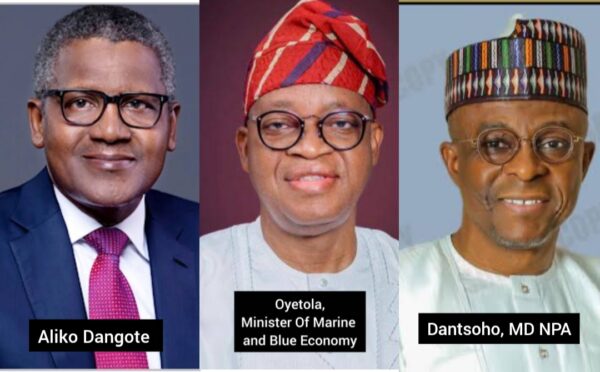
The two-year stewardship of the Managing Director of the Nigerian Ports Authority (NPA), Dr. Abubakar Dantsoho, has generated mixed reactions across different quarters, as expected. However, beyond the divergent opinions lies a growing body of measurable achievements that have earned the administration widespread commendation and underscored the difference in overall public sentiment.
Since his appointment by President Bola Tinubu on July 12, 2024, available performance records indicate a clear positive trajectory across key operational, financial, and institutional indicators. Although longstanding structural challenges within Nigeria’s port system remain a work in progress, the Dantsoho-led management has demonstrated a strong commitment to repositioning the nation’s ports for greater competitiveness and sustainability.
This special report examines the administration’s performance through the lens of investment inflows, financing commitments, and private sector capital attraction. It seeks to answer critical questions: What is the value of these investments and financing commitments? What factors have rekindled investor confidence in Nigeria’s ports? And what impact are these initiatives having on operational costs, efficiency, stakeholder confidence, and the country’s maritime reputation?
At the end of its second year, the administration’s investment drive has been largely concentrated on infrastructure modernisation, green port initiatives, and the expansion of public-private partnerships (PPPs).
Notably, these achievements consist primarily of secured financing arrangements and investment commitments rather than fully disbursed funds. Nevertheless, they represent significant milestones that signal renewed investor confidence and provide a strong foundation for the long-term transformation of Nigeria’s port industry.

NPA, with the backing of the Minister of Marine and Blue Economy, Adegboyega Oyetola, and President Bola Tinubu, has secured a landmark US$1 billion Port Modernisation and Reconstruction Programme designed to overhaul Nigeria’s ageing port infrastructure.

The programme will comprehensively rehabilitate quay walls, deepen navigation channels, automate port operations and upgrade cargo-handling equipment at Apapa and Tin Can Island Ports in Lagos, as well as Port Harcourt, Onne, Warri and Calabar ports.

A major component of the financing package is the £746 million UK Export Finance (UKEF) facility dedicated to the reconstruction of Apapa and Tin Can Island ports, making it one of the largest infrastructure financing arrangements ever secured for Nigeria’s maritime sector.
Although the project was initially expected to commence in the first quarter of 2026, implementation gained momentum after the Federal Government commenced payment of its counterpart funding and loan servicing obligations in July 2026.
According to the Managing Director of the NPA, Dr. Abubakar Dantsoho, physical construction is expected to begin in the third quarter of 2026, with the first visible improvements anticipated before the end of the year. The Lagos ports reconstruction programme is projected to last about 48 months, with completion targeted for 2030.
When completed, the project is expected to reduce vessel turnaround time by about 50 per cent, improve cargo-handling efficiency, deepen navigation channels from between 14.5 and 16.5 metres in strategic locations and significantly strengthen Nigeria’s competitiveness against neighbouring West African ports.
If the port modernisation programme represents a landmark infrastructure financing initiative, an even more significant milestone may well be Nigeria’s biggest port concession agreement since the commencement of port reforms in 2005.
Under the Dantsoho administration, the NPA secured an estimated US$1 billion Foreign Direct Investment (FDI) through a 45-year Public-Private Partnership (PPP) concession agreement with Nigerdock for the development of Snake Island Port. Signed in November 2024, the agreement provides for the development of an 85-hectare multipurpose green port with three terminals within the Snake Island Integrated Free Zone in Lagos.
The investment is expected to expand cargo capacity, attract additional private capital, generate employment and strengthen Nigeria’s position as a regional maritime hub.
The green transition agenda also gathered momentum in September 2025 when the NPA and West Africa Container Terminal (WACT)-APM Terminals Nigeria signed a Memorandum of Understanding for a US$60 million Green Port and Container Electrification Project at Onne Port in Rivers State.
The project seeks to electrify container handling operations, reduce carbon emissions and align Nigeria’s port operations with global decarbonisation standards under the policy direction of the Federal Ministry of Marine and Blue Economy. Consequently, Onne Port is increasingly being recognised as Nigeria’s first emerging green port.
Another major investment prospect is the proposed Olokola Deep Seaport being promoted by the Dangote Group as part of its Vision 2030 industrial expansion strategy.
Situated within the Olokola Free Trade Zone (OKFTZ), spanning Ogun and Ondo States, the proposed maritime and industrial complex will occupy more than 10,000 hectares and is designed to become Nigeria’s largest privately developed deep seaport.
The facility is expected to surpass the Lekki Deep Seaport in size and draft, serving as a dedicated export and import gateway for Dangote’s expanding industrial operations, including petroleum products, fertilisers, petrochemicals and future Liquefied Natural Gas (LNG) exports.
Beyond easing pressure on Apapa and Tin Can Island ports, the project is expected to boost Nigeria’s non-oil exports, improve supply chain efficiency and strengthen intra-African trade under the African Continental Free Trade Area (AfCFTA).
Preparatory activities, including stakeholder consultations, land surveys, environmental impact assessments, household and economic tree enumeration as well as compensation planning, are currently underway. Contractors are expected to mobilise while full construction may commence in the last quarter of 2026.
Beyond these flagship projects, the NPA under Dantsoho has continued to court private capital through strategic investment tours covering Onne, Rivers, Calabar and Warri ports. These engagements reportedly generated multiple expressions of interest from both local and international investors for the development of Rivers, Calabar and Burutu ports.
The Authority has also advanced frameworks for private-sector participation in independent power generation within port environments, bunkering facilities, logistics parks, freshwater supply systems and ship repair and maintenance infrastructure.
Similarly, the NPA has continued to provide technical and regulatory support for strategic maritime infrastructure projects such as the Badagry Deep Seaport, Ibom Deep Seaport and Ondo Multipurpose Deep Seaport, all of which are expected to attract substantial future investments.
Complementing these physical investments are digital transformation initiatives, particularly the Port Community System (PCS), which is designed to integrate seamlessly with the National Single Window platform. The reforms are expected to simplify trade processes, improve transparency, reduce transaction costs and further enhance investor confidence in Nigeria’s maritime economy.
These developments reflect Dantsoho’s background as a career port administrator with more than three decades of experience within the NPA. His leadership philosophy has largely focused on operational efficiency, automation, infrastructure renewal, revenue optimisation and restoring Nigeria’s competitive advantage within the West and Central African maritime corridor.
*Revenue Growth and Operational Performance*
Have these investment initiatives translated into stronger financial performance?
Available records suggest they have.
Before Dantsoho’s appointment, the NPA generated approximately ₦501 billion in revenue in 2023. By the end of 2024, revenue had risen to about ₦894.86 billion, significantly exceeding projections, while about ₦400.8 billion was remitted into the Federation Account—almost double the previous year’s contribution.
Reports in 2025 indicate stronger performance, with revenue generation approaching ₦1.97 trillion against an ambitious target, accompanied by higher remittances and increased capital allocations for infrastructure renewal. For 2026, the Authority has set a revenue target of ₦1.489 trillion, with substantial emphasis on financing its modernisation agenda.
Operational indicators also point to measurable improvements. Cargo throughput recorded notable increases, driven largely by export activities, transshipment traffic and stronger performance at Lekki, Onne and other strategic ports.
Likewise, vessel turnaround time and cargo evacuation efficiency have improved through the deployment of the Electronic Truck Call-Up System, satellite truck parks and progressive automation initiatives aimed at reducing congestion, shortening cargo dwell time and improving transparency.
*Growing International Recognition*
The reforms have also enhanced Nigeria’s global maritime profile.
According to the World Bank/S&P Global Container Port Performance Index, covering the 2025 assessment period, Tin Can Island Port ranked among the world’s top ten most improved container ports, while Apapa Port also featured prominently among the leading performers globally.
The country’s growing influence has equally been reflected in Dantsoho’s election as the first Nigerian in decades to serve as President of the Port Management Association of West and Central Africa (PMAWCA). He was also elected Vice-President (Africa) of the International Association of Ports and Harbors (IAPH).
These appointments have strengthened Nigeria’s voice in regional maritime diplomacy, infrastructure financing, port development and broader engagements within the International Maritime Organization (IMO) framework.
Stakeholders across the maritime industry—including terminal operators, freight forwarders, logistics providers and advocacy groups—have acknowledged improvements in operational efficiency, investor confidence and the promotion of non-oil exports.
Industry observers also link these reforms to Nigeria’s improving trade balance and export competitiveness.
*Verdict After Two Years*
Based on available performance indicators, Dr. Abubakar Dantsoho’s first two years as Managing Director of the NPA represent a strong and encouraging performance in managing one of Nigeria’s most strategically important but historically challenged public institutions.
Revenue growth, infrastructure financing, increased private-sector participation, automation, operational improvements, enhanced regional influence and rising international recognition stand out as significant achievements.
His extensive institutional knowledge, combined with strong policy alignment with the Federal Government’s Marine and Blue Economy agenda, appears to have accelerated reforms that might otherwise have taken much longer to achieve with a political appointee.
Nevertheless, significant challenges remain.
The ultimate test of this administration will lie in the successful execution of the ambitious capital projects, seamless implementation of the Port Community System and National Single Window, effective decongestion of Lagos ports through the development of eastern ports, and sustained reduction in the cost, delays and unpredictability associated with doing business at Nigerian ports.
At the two-year mark, the trajectory is undoubtedly positive. The challenge now is sustaining the momentum, delivering fully on the promises of modernisation and ensuring that today’s investment commitments translate into long-term economic transformation.
For Dantsoho and his management team, continued stakeholder collaboration, policy consistency and disciplined execution will determine whether this promising reform agenda ultimately becomes a defining chapter in the history of Nigeria’s maritime sector.