
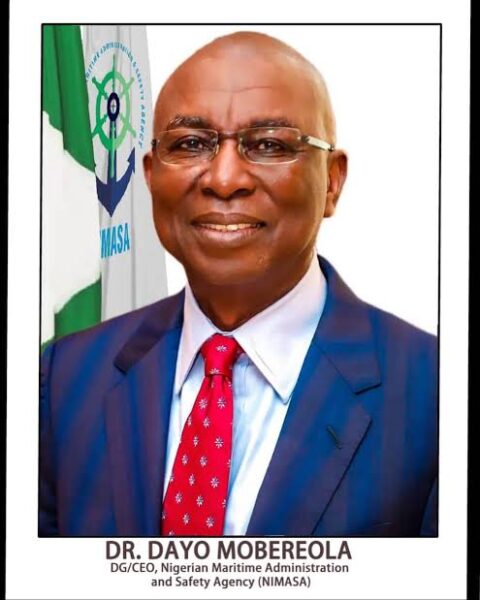
I had a dream. Although anonymous, it was remarkably surreal, as it addressed some of the journalistic questions surrounding developments at the Nigerian Maritime Administration and Safety Agency (NIMASA). I, like many other media colleagues, had long waited for the agency to address these concerns, but to no avail.
In the dream, I had a conversation with a chocolate-coloured male personality at a highbrow restaurant in Victoria Island, Lagos. I engaged him in a broad discussion about developments in NIMASA. Nevertheless, this segment provides answers to some compelling issues currently generating public debate in the maritime industry, including the whereabouts of the missing modular floating dock, the disbursement of the Cabotage Vessel Finance Fund (CVFF), the review of the Cabotage Act, and other related matters.
What makes this dream-world interview particularly interesting and imperative is that the Director-General of NIMASA, Dr Dayo Mobereola, has remained largely inaccessible to the media, while the agency’s media team has been less than forthcoming in responding to official media enquiries.
However, this is where journalistic ethics becomes decisive. Can this qualify as a conventional journalistic interview? Yes! Psychological, philosophical, literary and communication theories provide conceptual foundations for conducting an interview in a dream and subsequently publishing the material in real life. These include Dream Incubation Theory, Psychoanalytic Theory of Dreams, Constructivist Theory, Dialogic Imagination Theory and the Oneiric Journalism Conceptual Framework, which is perhaps the most applicable to this dream-journalism enterprise.
Enjoy the reading.

Why is the modular floating dock still lying unused? If Liberia, South Africa and some other African countries are generating revenue from ship repairs and dry-docking services, why can’t Nigeria do the same? By the way, we learnt that the facility is missing. NIMASA’s spokesperson said he could not confirm its location, and the operators could not confirm its whereabouts either.

The modular dock was procured primarily to help build local capacity. Initially, I believe it was intended to be located at a school in Okerenkoko, Delta State, where students would gain hands-on practical experience. The idea was to develop local capacity while also making the facility commercially viable.

Students cannot acquire practical experience without the necessary equipment and facilities. They were expected to work with patronage from local vessel owners. That was where we should have started.
I was particularly proud when I took some Swedish students to see the modular dock at Niger Dock during a meeting, before the accident.
Even within this department, we wrote to enquire about how the modular dock could be activated to support capacity development. However, we have yet to receive any response.
Meanwhile, we are engaging several private-sector operators with dry-docking facilities, including Chief Greg Ogbeifun. They have invested considerably in their own facilities, and we hope to meet with them during one of our stakeholder engagements.
If we remain silent, we will continue to fuel speculation that an entire modular dock has gone missing. That is not true. It is too massive to disappear. Where would it disappear to? The facility is enormous. Someone might acquire a vessel and change its name, but you cannot simply change the identity of a modular dock. It is unique.
The way it works is that it is submerged. I was surprised when I saw the size of the vessel it accommodated and subsequently lifted.
But in this country, ships have gone missing before, so anything can happen. Why does NIMASA appear uncertain about what to do with the dry-dock facility acquired to develop local capacity for the Cabotage policy? There appears to be no coherent government policy framework or strategy for the ship-repair and dry-docking industry. How do you intend to effectively deploy the modular floating dock and maximise its potential?
This explains why we have been engaging stakeholders. We are all working towards building a better Nigeria, and contributions from stakeholders will help us develop a robust policy framework.
We are inviting the fisheries associations, barge operators, shipowners and other relevant stakeholders to share their perspectives, which we will incorporate into our research findings.
Different countries, including South Africa and Togo, have adopted different approaches to these issues. Every country must develop a strategy that reflects its unique operating environment.
Why not give cargo priority to local shipowners as an incentive?
We want to change the narrative of Nigerians constantly feeling that the country is happening to them. There should be no interference. We have moved beyond intervention; the focus should now be on efficiency and competence, whether in personnel, equipment or operational standards. That is the essence of the Cabotage policy: building local capacity.
The Nigerian Content Development and Monitoring Board (NCDMB) has been engaging with us. What we are working towards in the area of cabotage is ensuring that whenever there is work to be done, priority is given to Nigerian-built and Nigerian-registered vessels.
It is only when such vessels are unavailable that we process applications for waivers. That is the approach we are pursuing.
This is how we can support local operators. For instance, if a product requires highly specialised handling, you will not award the contract to someone simply because they are your brother or sister. You will award it to an operator who has demonstrated the capacity to deliver efficiently, meet deadlines and avoid environmental damage, among other requirements.
The Cabotage regime is designed to ensure that Nigeria receives first preference in the carriage of goods. We are working towards achieving this, but we also want to improve the system. That is why we encourage Nigerians to build or acquire vessels.
We are also encouraging operators to consolidate their resources. A few Nigerians are beginning to explore this approach. Previously, everyone operated independently. However, two or three individuals can come together to acquire and operate a vessel.
The NCDMB and NIMASA will support them with contracts where they demonstrate the required capacity.
We also notify shipowners about available manpower capacity, including qualified personnel who can handle their vessels. We direct them to the ship registry and the manning department to obtain the names and details of qualified professionals.
We do not interfere in their recruitment processes, but we provide oversight. Our zonal officers are expected to engage with them, observe the recruitment process and ensure that it is fair.
We also have the Collective Bargaining Agreement (CBA), which ensures that Nigerian seafarers are not shortchanged. Our zonal offices are responsible for enforcement. We want to ensure that Nigerian seafarers employed onboard vessels are not treated as cheap labour. They must receive remuneration comparable to that of their foreign counterparts performing similar duties.
We are enforcing these provisions. In the course of doing so, we identified certain loopholes that some operators were exploiting. We have therefore proposed a review, and I understand that management is working on it.
That is why we are encouraging stakeholders with relevant ideas and recommendations to come forward now. This is the right time to contribute to the ongoing review of the Cabotage Act.
How many Cabotage vessels does Nigeria have?
We have processed 545 Cabotage vessels. However, the Shipping Registry can provide the comprehensive figure because not all vessels are registered with us for one reason or another. The 545 figure covers the vessels registered with us under the special cargo category for cabotage.
Why is NIMASA going back and forth on the disbursement of the Cabotage Vessel Finance Fund (CVFF)?
Regarding disbursement, under the former National Maritime Authority (NMA), we operated what was known as the Ship Acquisition and Ship Building Fund (SASBF). Unfortunately, the framework was loose and was not properly managed.
Our funds are still out there. People treated the money like a national cake. However, because the funds were provided by the government, it was easier for the government to absorb the situation, and eventually, everyone went quiet.
But the CVFF is different. It is funded through a two per cent surcharge on contract sums paid by operators. In other words, it represents contributions made by industry operators. It is not money that should be handled carelessly.
People keep asking for disbursement. But how should we disburse the money? Should we simply take people’s contributions and hard-earned resources and hand them over without adequate safeguards? No.
We therefore sought a strategic, robust and comprehensive framework that would ensure that beneficiaries do not default and that only qualified applicants receive the funds.
I can tell you that the reason the CVFF has not been disbursed yet is the need to establish this strategic and comprehensive framework. It is a matter that directly affects the businesses of the operators.
So far, how many people have applied?
We have received more than 60 applications.
The process is transparent and accessible to everyone. Anyone who claims to have applied can log into their portal and check their application status.
Only three applications have progressed to the CVFF Secretariat, and even among those three, only one has advanced beyond that stage, although it remains subject to certain conditions.
What is the purpose of the CVFF? It is intended to increase the tonnage and capacity of the local fleet. That is the fundamental objective.
The particular applicant who has advanced furthest, subject to conditions, is seeking to bring in a vessel that already has a permanent flag and intends to use the fund for refinancing.
He has successfully completed the earlier stages of the process. However, when the application reached the Secretariat, we discovered that the vessel intended for refinancing already had a permanent flag.
That means it no longer qualifies under the Cabotage requirements. The condition is that he must either acquire a similar qualifying vessel or de-flag the existing vessel.
Is the vessel flagged in Nigeria or Liberia?
I do not know the country under whose flag the vessel is registered, but we were informed that it has a permanent flag. We are investigating the matter. This is no longer business as usual.
The applicant successfully passed through all the previous stages until the application reached the Cabotage Secretariat.
One aspect of the application is satisfactory and ready to proceed. However, the second vessel, which would balance the funding arrangement, does not meet the requirements.
If the applicant decides to withdraw the second vessel from the application, we can provide the equivalent funding for the first vessel. He is the one holding up the process, not NIMASA.
The other two applicants also have certain conditions they must satisfy.
The money is available for qualified applicants. They only need to fulfil the requirements. The process will proceed without interference, not even from the Director-General.
Even the Minister indicated his willingness to sign a document to reassure the public that the Fund is real. We recommended the application to him for approval, pending the fulfilment of the outstanding conditions. At that point, he realised that he could not approve it.
There is a provision in the documentation that prevents him from granting approval until the stipulated condition has been met.
Ultimately, nobody is withholding the CVFF. The Fund is available; the operators are the ones holding themselves back by failing to meet the requirements.
The application process is conducted online through the portal. Applicants are guided through the various stages, much like an interactive online platform.
When you log in, the system prompts you to upload the required information. You upload the documents and proceed to the next stage until the application is completed.
Every applicant has gone through the respective stages of the process. That is how we arrived at the three applications that have progressed, while the others remain under consideration.
As you can see, nobody is holding back the Cabotage Fund. It is the operators’ money, contributed by them, and it is not going anywhere. It remains available to them once they fulfil the necessary requirements.
The SASBF had its shortcomings, but it also recorded some successes, with Capt. Emmanuel Iheanacho being an example of the latter. While there are risks, there are also success stories. The objective of the CVFF framework is commendable: to promote shipping in Nigeria and empower indigenous operators. However, will CVFF beneficiaries be restricted to operating their vessels only within Nigerian waters, particularly in an era of the African Continental Free Trade Area (AfCFTA)?
That is incorrect information. Our objective is to build local capacity, from which operators can expand into other markets.
We cannot prevent Nigerian operators from conducting business elsewhere. However, their vessels must fly the Nigerian flag, be Nigerian-owned, manned by Nigerians and registered in Nigeria.
We have international shipping companies such as China Shipping and MAERSK operating here, but their vessels do not fly the Nigerian flag. They are foreign-flagged vessels.
Similarly, when Nigerian vessels operate in Togo or other countries, they are regarded as foreign vessels in those jurisdictions. But that is not what the Cabotage policy is about.
Building indigenous capacity does not mean restricting Nigerian vessels to local waters. However, shipping is capital-intensive, and our operators often lack the financial resources required to acquire large vessels.
Consequently, many can only afford smaller crafts capable of conducting coastal trade between Nigeria, Togo, Cameroon and other neighbouring countries.
That is another reason I keep encouraging them to consolidate their resources. If they come together, they can acquire larger vessels, including liners, and expand their operations.
Some operators are already considering this approach, and we will continue engaging those we have spoken with.
Whenever we meet with operators, we also want to understand the framework that can support their expansion and determine where government intervention may be necessary.
Possibility of being a bit more flexible: If we insist on having Nigerians onboard, can we consider a percentage of 60 to 70 per cent Nigerians instead?
Shipping is an international business, and it is very expensive. You would not want to give someone an opportunity to work onboard a vessel simply because the vessel is Nigerian.
When we begin to have more Africans with the necessary expertise and capacity, we can undertake further research on the matter.
Out of patriotism, the requirement was that Nigerians should occupy all positions onboard. However, this has increasingly become a challenge. It is a beautiful policy in principle, but in reality, it is one of the reasons the industry appears to be going round in circles after all these years. Can we consider a requirement of 60 to 80 per cent Nigerian personnel instead of insisting on 100 per cent, especially given that shipping is a highly technical business?
It cannot always be achieved, and I do not think we have all the required expertise available across every category.
Do you know why we cannot simply reduce the percentage? Compliance is 100 per cent, not 99.9999999 per cent.
Under the Companies and Allied Matters Act (CAMA), the applicable requirement is 60 per cent. But under cabotage, the requirement is 100 per cent. If we begin to lower the standard, we will create additional challenges.
However, as I mentioned earlier, we have a waiver system. Whenever we establish that the required capacity or competence is unavailable locally, we can process a waiver.
There is therefore some flexibility. For instance, if we examine the maritime labour market and discover that the required officers are unavailable, or the Ship Registry confirms that the necessary vessels are not available, we can consider a waiver.
However, we do not compromise on registration. A vessel must first be registered in Nigeria before we can consider processing any waiver.
Furthermore, if your vessel is foreign-built, you must meet the applicable payment requirements.
What are we trying to communicate? Even if you are Nigerian and own a vessel, you must bring it home and register it accordingly. We are encouraging indigenous operators to bring their vessels into the Nigerian registry.
If we go beyond the established requirements, the same Nigerians will come out with placards to protest.
On insecurity in coastal waters, why can’t we achieve zero security incidents along the eastern port channels, as has been achieved in some areas of the Gulf of Guinea? Shouldn’t charity begin at home, particularly regarding the high cost of freight to the Eastern Ports?
Insecurity is a global challenge; it is not peculiar to Nigeria.
At a particular point, there were attempts to exploit the situation by requesting permission to carry arms onboard vessels. However, we rejected the request because we could not guarantee control over what might happen once such permission was granted.
I believe that this also encouraged the government to engage grassroots communities in addressing the problem because local people understand the locations and activities of the criminals.
However, insecurity has reduced significantly in our waters, particularly in the South-West and South-South. Even the International Maritime Bureau has acknowledged this improvement. They have satellite monitoring capabilities, just like the United States Coast Guard.
They can monitor the activities of these criminals, even in the most remote areas, and observe the measures Nigeria is implementing to discourage them.
These efforts are yielding results, and I hope the government will sustain them.
Speaking about security in the South-East and South-South, as well as port development, I know that private security companies operate in this country. Private shipowners often engage security personnel to facilitate the movement of their cargo. The question operators frequently ask is whether the sea is open or closed. When the sea is open, they can proceed. When it is closed, they stay back, but they still incur security-related costs.
As recently as three or four years ago, if you wanted to bunker a vessel of about 2,000 or 2,500 tonnes, you could be paying approximately ₦6 million for security. This was in addition to the bunkering costs.
Who provides the security? Naval officers and senior personnel within the naval establishment, including the Chief of Naval Staff and others.
We had a significant incident involving this issue. However, it was denied because it was not officially acknowledged. One of our officers raised the matter because our personnel were involved, and we were not particularly pleased about it.
There are offshore and onshore security companies registered in the country. I know the challenges they face in their operations, but shipowners and other operators understand how to engage them.
That brings me to one of my greatest concerns regarding our trade terms, particularly Free on Board (FOB). We are deceiving ourselves in this country because Nigerians are moving cargo to Ghana and Togo under TTO and TTT arrangements.
They move cargo to those destinations, transfer it to other vessels and subsequently transport it to Europe or wherever the final destination may be.
Nigerians often demand certain arrangements and concessions, forgetting that commercial transactions are being concluded under different trade terms.
Some Nigerians also purchase refined petroleum products produced locally from the creeks and supply them to the numerous tank farms across the country. Yet, NIMASA and other regulatory agencies appear too weak to monitor and check these activities effectively.
Consequently, when marketers purchase these products, they still sell them at import prices. Where a waiver is required, they present the necessary documents and obtain it. What do you say?
As we have observed, some operators engage in extensive commercial activities under the Cabotage regime. In certain circumstances, we have allowed these activities to continue because we do not want to disrupt legitimate businesses.
Nevertheless, we are seeking ways to address these practices, and that is another reason we need a comprehensive policy framework. Without an appropriate legal framework, it will be difficult to enforce the necessary controls.
The Act provides that when a vessel moves cargo from one port to another within the country, such an activity falls under cabotage. Where local capacity is unavailable, we can consider granting a waiver.
This also applies to vessels involved in ship-to-ship (STS) operations. Some vessels are too large to enter certain ports, so they conduct ship-to-ship transfers. Such activities also fall within the scope of cabotage, and the applicable charges must still be collected.
What we do not want to stop is the legitimate entry and movement of foreign vessels into Nigerian waters.