
TRENDS IN ARMS TRADE: Customs Intercepts 36 Shipments In 11 Years, Poor Database Blights Records

- DPV hits N20.23 billion as sophisticated concealment methods emerge
Amid rising insecurity across Nigeria and intensified efforts to curb the illicit movement of firearms, the Nigeria Customs Service (NCS) recorded 36 arms and ammunition seizure incidents between 2015 and 2026, with a combined Duty Paid Value (DPV) of N20.23 billion in 10 of the cases for which DPV figures were available.
An investigation by MMS PLUS shows that the interceptions occurred through Nigeria’s seaports, land borders, vehicles and other smuggling routes, with a marked escalation in major maritime and container-based seizures from 2017.
The investigation also reveals an evolving pattern of arms trafficking, from rifles concealed in containers and vehicles to increasingly sophisticated methods involving household goods, sanitary wares, Plaster of Paris (POP), cement, charcoal, imported vehicles and knocked-down firearm components.
The development raises fresh questions about the capacity of Nigeria’s ports, borders and trade-monitoring systems to identify illicit consignments before they enter the country.

The most alarming recent development occurred in 2026, when Customs intercepted hundreds of rifles in separate consignments at the Tin Can Island Port, Lagos.
In one case, knocked-down firearm components were assembled by experts from the Nigeria Customs Service Armament Unit and the National Centre for the Control of Small Arms and Light Weapons (NCCSALW), resulting in the recovery of 399 pump-action rifles.
In another major interception, Customs uncovered components which were subsequently assembled into 204 pump-action rifles.
The pattern, however, is not confined to the maritime sector.

The 2026 seizures indicate that the threat remains active despite the deployment of intelligence-led enforcement, risk profiling, technological tools and inter-agency collaboration.
For policymakers, the central question is therefore no longer simply how many weapons Customs has seized.



It is also how many consignments may have passed through Nigeria’s ports and borders undetected; who financed them; who imported and cleared them; where they were destined; and how many criminal networks remain capable of exploiting legitimate trade infrastructure.

MMS PLUS investigations further indicate recurring patterns involving importers, vessels, shipping routes and concealment methods.
Available records indicate that five illicit arms and ammunition shipments originated from the United States of America, while eight were routed through Turkey.
Five of the shipments were reportedly linked to Great James Oil & Gas Limited as consignee, allegedly represented by Ifeuwa Moses Christ and Emeka Umeh Festus.
Other individuals were also reportedly linked to various arms shipments during the period under review.
Available records indicate 14 reported cases of prosecution, 23 arrests and five convictions. One Customs officer was reportedly arrested over alleged complicity.
However, the investigation found no clearly documented ongoing investigations in the records reviewed.
These figures raise questions about the extent to which seizures translate into successful prosecution, conviction and disruption of the networks behind the illicit arms trade.
Perhaps as disturbing as the seizures themselves is the apparent weakness of the available historical data.
MMS PLUS observed that the NCS does not appear to maintain a publicly accessible, comprehensive statistical series providing a complete year-by-year breakdown of arms and ammunition seizures, classified by containers, vehicles, land borders and other concealment or transportation methods.
The absence of a consolidated database makes it difficult to establish the precise scale and trajectory of arms trafficking through Nigeria’s legitimate trade channels.
The investigation also identified discrepancies in some official figures, classifications and disclosures across different seizure reports.
While such inconsistencies may partly reflect differences in reporting periods, operational classifications or subsequent verification, they underscore the need for a centralised and transparent national database on arms interceptions.
The gaps also raise legitimate questions about internal controls, information management and possible institutional weaknesses within the enforcement chain.
Some of the most significant interceptions occurred at the Tin Can Island Port.
In January 2017, Customs intercepted 661 rifles at the port. This was followed by the seizure of another 440 pump-action rifles in May 2017, while 1,100 rifles were intercepted in September, with another 470 reportedly seized later in the year.
In 2018, Customs seized 1,599 assorted firearms and 2,298 live cartridges from three containers at Tin Can Island Port.
The weapons were eventually handed over to the National Centre for the Control of Small Arms and Light Weapons (NCCSALW) in 2025, seven years after their interception.
The prolonged interval between seizure and handover raises additional questions about the management, custody and eventual disposal of confiscated firearms.
In 2020, Customs intercepted 73 locally manufactured rifles and 891 cartridges from a truck in Kebbi State, while the Federal Operations Unit (FOU) Zone C reported the interception of 5,200 cartridges concealed in a Toyota Sienna in Cross River State.
Customs continued to record significant interceptions in subsequent years.
In 2022, the Tin Can Island Command alone reported 20 arms and 2,594 pieces of ammunition, while additional interceptions occurred along land and border routes.
The scale of the problem became particularly evident in 2023 and 2024.
According to Customs, approximately 60 per cent of the 20 significant shipments reviewed occurred in 2023.
For 2024, the Service reported seizures involving approximately 900 firearms and 113,472 rounds of ammunition.
One of the most significant interceptions occurred at Onne Port, Rivers State, where Customs seized a 40-foot container containing 844 rifles and 112,500 rounds of live ammunition.
For 2025, the Federal Operations Unit Zone A reportedly intercepted 15 rifles and approximately 4,841–4,891 rounds of ammunition concealed in a Nissan Almera in Ogun State.
The variation in the reported ammunition figure further illustrates the data inconsistencies encountered during the investigation.
The 2026 seizures have taken the sophistication of concealment to another level.
In July, Customs reported the interception of 399 Jojef pump-action rifles from a container that arrived at Tin Can Island Port. The components had initially been discovered in knocked-down form and were subsequently assembled by enforcement experts.
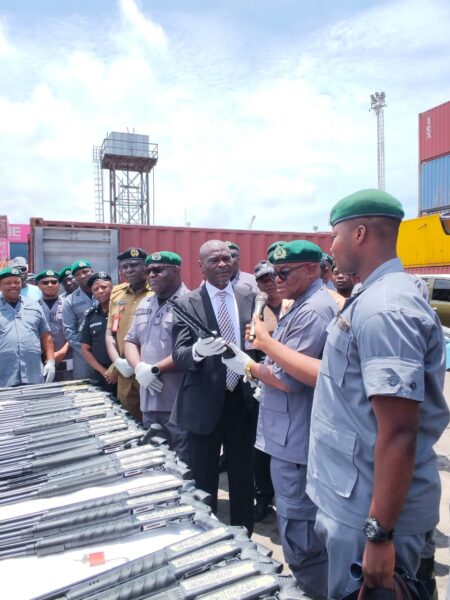
Then, on August 31, 2026, Customs disclosed another major interception involving 204 MAS 49 ALTER MAGNUM pump-action rifles, concealed among used household goods.
MMS PLUS reports that the latest seizure at Tin Can Island Customs Command involved firearms allegedly imported from Turkey.
The seized weapons were immediately handed over to the National Centre for the Control of Small Arms and Light Weapons (NCCSALW), the institution mandated to coordinate efforts against the proliferation of small arms and light weapons.
The Comptroller-General of Customs, Adewale Adeniyi, represented by the Deputy Comptroller-General in charge of Enforcement, Inspection and Investigation, Timi Bomodi, disclosed details of the seizure during a media interaction in Lagos.
According to Customs, the firearms were concealed in a 20-foot container, TEMU 184536/9, shipped into Nigeria aboard MV Algeciras Express on August 16, 2026.
The container was subjected to a 100 per cent physical examination on August 18, leading to the discovery of knocked-down firearm components concealed among declared used goods, including furniture, refrigerators, solar panels and detergents.
Following the discovery, Customs said it assembled a team of experts from its Armament Unit and the NCCSALW to examine and assemble the components.
The exercise resulted in the recovery of 204 pump-action rifles, alongside several leftover components.
Customs listed the components as:39 trigger pistols;58 locking lugs;53 charging handles;
55 pistol-grip screws;56 springs; 56 trigger groups;38 forward grips;
57 forward-grip latches;
56 pistol grips;54 barrels; and two U-plates.
Adeniyi said the seizure was further evidence that the Service had maintained heightened surveillance and intelligence-led enforcement against the movement of illicit firearms through Nigeria’s ports and borders.
He also pledged continued collaboration with relevant authorities to identify, intercept and investigate consignments considered threats to national security.
According to the Customs boss, the operation demonstrated the importance of intelligence sharing and collaboration among the Office of the National Security Adviser, the Nigeria Customs Service, the NCCSALW and other security agencies.
He said the government’s approach to combating arms smuggling and other criminal activities at the ports and borders was yielding results, as demonstrated by the latest seizure and previous interceptions.
Adeniyi warned smugglers, arms traffickers and their collaborators that Customs would continue to deploy intelligence-led enforcement, technological tools, risk profiling and inter-agency collaboration to prevent illegal firearms from entering the country.
The Customs Area Controller of the Tin Can Island Command, Comptroller Joseph Anani, said the repeated firearms seizures sent a clear signal that the Command would not become a weak link in the enforcement of import prohibitions.
He said the Command would particularly resist the movement of dangerous items capable of threatening Nigeria’s peace and security.
Anani commended the Comptroller-General for his leadership, the NCCSALW for its collaboration and Customs officers for what he described as professionalism in the operation.
According to him, the handover of the seized firearms was not merely an enforcement exercise but part of a broader responsibility to protect lives, preserve national security and ensure that Nigeria’s ports remain channels for legitimate trade and economic development rather than conduits for instruments of violence.
The Zonal Director, South-West Zone of the National Centre for the Control of Small Arms and Light Weapons, CP Abiodun Alamutu (rtd.), also commended Customs for the interception and the collaborative efforts between both institutions.
Alamutu said the weapons could have posed a serious danger to society had they not been intercepted.
The growing frequency and sophistication of arms seizures point to a disturbing intersection between Nigeria’s legitimate trading system and the illicit arms market.
From containers of household goods to vehicles, charcoal, sanitary products and knocked-down firearm components, traffickers appear to be constantly adapting their methods to exploit weaknesses in Nigeria’s cargo-screening and border-control systems.
The seizure figures tell only part of the story.
The bigger challenge is developing a single, verifiable and continuously updated national arms-interception database linking Customs, the NCCSALW, the police, the military, the National Drug Law Enforcement Agency, port operators, shipping lines and other relevant institutions.
Such a database should capture, at minimum, the date and location of interception, container number, vessel, importer and consignee, declared cargo, country of origin, port of loading, concealment method, quantity and type of firearms and ammunition, suspects, arrests, prosecution status, convictions, final disposition of seized weapons and DPV.
Without such a system, Nigeria risks knowing the number of weapons it has intercepted without fully understanding the networks, routes and institutional vulnerabilities that enabled those weapons to approach its borders in the first place.
The evidence gathered by MMS PLUS suggests that Nigeria’s fight against illicit arms trafficking has entered a new phase—one in which intelligence, technology, data integrity and institutional accountability must advance as rapidly as the sophistication of the traffickers themselves.