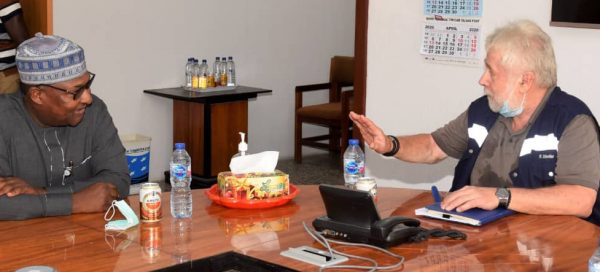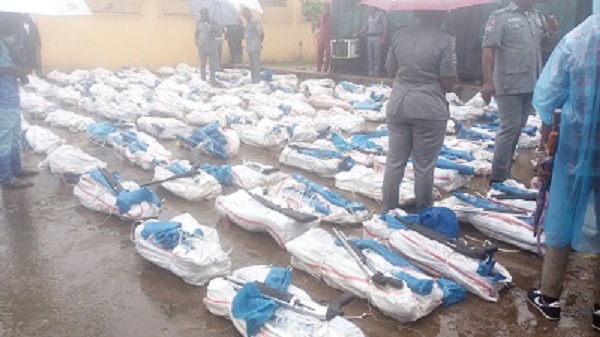


The Nigeria Customs Service, Seme Area Command, on Monday, engaged border stakeholders, including community leaders, heads of various security agencies, the clearing agents, and the Nigerian Embassy in the Benin Republic, with a view to addressing border-related crimes and trade barriers and improving legitimate trade along the Seme Border Corridor.
Addressing journalists, the Customs Area Controller in charge of the Command, Wale Adenuga, said that the Service was seeking solutions to building the Lagos-Abidjan Corridor.
He lamented that the checkpoints along the Seme Border Axis serve as a warning, adding that will no longer be business as usual at the end of the meeting.

“The checkpoints we have on the roads are too much; it is disgraceful. The Comptroller-General of Customs, Adewale Adeniyi, has directed that the checkpoints be reduced.
He also said that on no account should anyone delay a legitimate business. After this meeting, it will not be business as usual; we shall create an implementation committee on all we have discussed. The meeting would continue to be held; it is not a one-off meeting. The CGC is now the number one customs officer in the world, and Nigeria cannot be different from what is obtainable in other parts of the world. This is one of the major reasons for this meeting: we want sanity on our roads. The more we facilitate legitimate trade, the better for our country. When trade thrives, crime reduces. That is the vision our Comptroller-General, Adewale Adeniyi, has consistently championed, building a legacy of trade facilitation and a conducive environment for economic growth,” Adenuga stated.

A community leader from Apa Kingdom, Prince Joseph Agoro, argued that the majority of the fights and conflicts on the border corridor are caused by camp boys recruited by security agencies along the border route.


He described the practice as embarrassing, stressing how commuters and residents are often harassed and questioned by individuals who are not legitimate officers.

“Multiple checkpoints are already problematic. It is more embarrassing to be stopped by security agencies, and someone who isn’t an officer would begin questioning passengers. We don’t know who is attending to us. There is no way the resident and villagers wouldn’t complain about such unfair treatment from the camp boys. Why should we be harassed just for living along the border corridor?” Agoro said.
On his part, the Oba of Kweme Kingdom in Badagry, Oba Sejiro Ogungbe, expressed appreciation to the customs for reducing frequent clashes between customs and smugglers in communities, which he said often leads to avoidable deaths.
Responding to some of the issues raised, Adenuga assured that the multiple checkpoints would be reduced in no distant time.
He added that the CGC is working closely with the Inspector-General of Police and the National Security Adviser to address the issue.
“If you don’t have any business to do on that road, don’t come there. If you refuse to comply, you will be arrested because I have the backing of the CGC,” Adenuga warned.
On the use of camp boys, Adenuga warned that any officer who makes use of camp boys will be dealt with appropriately, as the Service has since abolished the use of camp boys.
Representative of the Nigerian Air Force, Badagry, Capt. H.I. Medugu, thanked Comptroller Adenuga for initiating the stakeholders meeting due to several complaints along the border route.
The Nigerian Ambassador to the Benin Republic, Ambassador Olukayode Olugbenga Aluko (represented by the Defence Attaché, Colonel S. Yahaya), assured that all the takeaways at the meeting would be fully implemented.
The Seme Border Corridor, a vital gateway between Nigeria and the Benin Republic, has long faced challenges ranging from trade bottlenecks to security-related conflicts. Multiple checkpoints, extortion, the use of unregulated “camp boys”, and clashes between border communities and security operatives have hindered legitimate trade and strained relationships along the route. These issues have raised concerns from both local stakeholders and international partners, threatening regional integration efforts, especially on the Lagos-Abidjan trade corridor, an important route under the Economic Community of West African States Trade Liberalisation Scheme.