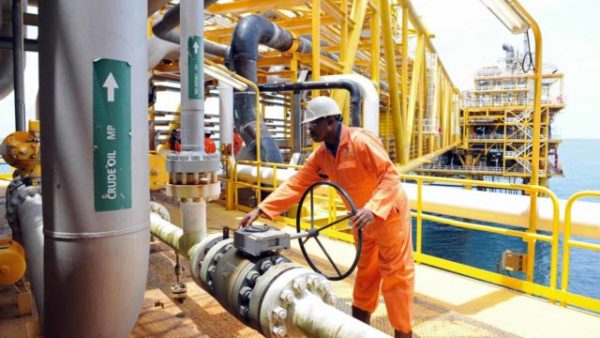


The Nigerian National Petroleum Company Limited has insisted that it supplied all available crude oil cargoes allocated under the Federal Government’s naira-for-crude initiative to the Dangote Petroleum Refinery, saying there had been no withholding on its part.
The national oil company stated this even as a top management official of the Dangote Group disclosed to media hat the refinery was receiving just four million barrels of crude oil monthly under the arrangement, instead of about 13 million barrels envisaged after President Bola Tinubu’s 2024 directive.
The refinery had attributed its decision to switch from naira-denominated fuel sales to dollar transactions to the crude supply shortfall, saying it would also increase exports of refined petroleum products to earn foreign exchange.

Responding on Monday, the NNPC, through its spokesman, Andy Odeh, said the company had fully discharged its obligations under the naira-for-crude policy. “As a 7.25 per cent equity shareholder in Dangote Petroleum Refinery and Petrochemicals, NNPC Limited has a direct and genuine interest in seeing the refinery operate at full capacity. That is not in dispute.
“What the figures being cited require is context. Under the naira-denominated crude supply arrangement, NNPC Limited has allocated 100 per cent of all available naira crude cargoes to DPRP in 2026 — there has been no withholding on our part. Actual off-take in any period is shaped by several variables: crude availability, nomination timelines, and the refinery’s own operational scheduling.

Odeh said the NNPC has met its obligations to the refinery, saying the two parties are resolving any existing gaps together. “NNPC Limited has met its 2026 supply obligations to the refinery. Our engagement with DPRP management remains constructive, and where any gaps exist, we are resolving them together — as the partners we are.


“A fully supplied, fully operational Dangote refinery serving the Nigerian market is an obligation NNPC Limited shares without reservation,” he added.

However, the Dangote Group maintained that the crude volumes supplied under the arrangement were inadequate to sustain naira-denominated fuel sales.
A top management official of the Dangote Group had told media that crude supply under the naira-for-crude arrangement had been limited to just four million barrels monthly despite the increase in Nigeria’s crude oil production.
The official, who pleaded anonymity because of the sensitivity of the matter, said the refinery was now set to export a larger percentage of its products in exchange for foreign exchange.
“Since the traders have brought lots of imported products to the market, we are focusing on exports. We can’t, and we shouldn’t be fighting against the government’s policies,” the source said.
Our correspondent told the official that exporting without adequately supplying the domestic market would not be good for the country, but he responded with a question: “Is issuing massive import licences and releasing forex for imports good for the country, when 45 per cent of our production can meet 100 per cent of the entire country’s requirements in terms of petrol, diesel and aviation fuel?”
When told that the NNPC said it had increased crude supply to the Dangote refinery, the official replied, “Do you think that they will keep quiet if we process the naira crude and export the products? We are getting just four million barrels monthly.”
With the sale of petrol in dollars to local marketers, the Dangote official disclosed that the refinery would now process whatever crude it receives under the naira arrangement and supply the equivalent refined products in naira to the Nigerian market through the NNPC.
“We will account for every barrel of crude we receive against the naira payment by supplying equivalent products in naira. We will do that through the NNPC. The NNPC buys a lot from us,” he said.
The refinery had maintained that the inability to secure the expected crude volumes under the naira-for-crude initiative compelled it to abandon naira-denominated fuel sales and adopt dollar pricing for petroleum products.
Last week, the refinery announced a new dollar-denominated pricing template, fixing the ex-depot price of petrol at $0.779 per litre, diesel at $1.087 per litre and aviation fuel at $0.942 per litre.
The move has drawn criticism from petroleum marketers, who warned that it could increase pressure on fuel prices, although the Nigerian Midstream and Downstream Petroleum Regulatory Authority said the decision was consistent with the provisions of the Petroleum Industry Act, which allows refiners to recover their costs.
Supply worsens
Meanwhile, petrol supply in the Federal Capital Territory, Abuja, worsened on Monday with the closure of some major filling stations in Abuja and a fresh increase in the pump price of petrol.
Checks by one of our correspondents showed that some stations operated by NNPC Limited and MRS along the Airport Road Expressway were shut when visited on Monday.
At stations that were dispensing the product, petrol was being sold at between N1,250 and N1,280 per litre. Bovas sold petrol at N1,250 per litre, while Azman Filling Station at 6th Avenue dispensed the product at N1,280 per litre. Salbas also sold petrol at N1,280 per litre.
The development has further heightened concerns among motorists and other consumers over the rising cost and availability of petrol in the nation’s capital. For motorists in Abuja, Monday’s development meant longer searches for petrol, closed stations and prices as high as N1,280 per litre at outlets that had the product available.
Meanwhile, truck traffic has surged across major private petroleum depots in Lagos as marketers scramble for petrol supplies following the fifth consecutive day of suspended loading at Dangote Petroleum Refinery amid growing expectations that wholesale prices could rise when operations resume.
Expert reacts
Meanwhile, Professor Emeritus of Petroleum Economics and Principal Facilitator at the FUPRE Energy Business School, Wumi Iledare, said the Dangote refinery’s decision to sell petrol in dollars should be viewed within the broader context of petroleum economics and Nigeria’s energy security rather than merely the currency in which products are priced.
According to Iledare, the move is a commercial response to the realities of the global oil market, where crude oil, the refinery’s major feedstock, is traded in United States dollars.
Iledare explained that pricing refined products in dollars enables the refinery to reduce its exposure to exchange rate volatility and provides greater revenue certainty, although it shifts part of the foreign exchange risk to fuel marketers and, ultimately, consumers, where the costs are passed on.
He stressed that the refinery’s dollar pricing would not automatically translate to higher fuel prices, noting that domestic petrol prices would instead become more closely tied to movements in international crude oil prices and the naira-dollar exchange rate.
“Does this necessarily mean higher fuel prices? Not necessarily. What it does mean is that domestic fuel prices become more closely linked to two key variables: international crude oil prices and the naira-dollar exchange rate. If crude prices rise or the naira weakens, pump prices are likely to increase. Conversely, if crude prices decline or the naira strengthens, consumers should also expect prices to adjust downward. That is how a market-oriented pricing system is expected to function,” he said.
The petroleum expert maintained that despite concerns over dollar-denominated pricing, the Dangote refinery had strengthened Nigeria’s energy security by reducing dependence on imported petrol and improving the availability of petroleum products.
He, however, noted that domestic refining alone could not guarantee affordability, saying fuel prices would continue to depend on exchange rate stability, international crude prices, logistics costs and the level of competition in the downstream sector.
“The refinery has significantly improved the availability of petroleum products by reducing Nigeria’s dependence on imported PMS. That alone makes the country less vulnerable to disruptions in international supply chains and enhances supply reliability.
“This is why I would say that Dangote Refinery can shield Nigeria more effectively from supply shocks than from price shocks. Domestic refining improves energy security, but it cannot completely insulate Nigeria from global petroleum market dynamics because crude oil still has an international opportunity cost, whether it is refined in Lagos, Rotterdam, or Houston,” he stated.
On the implications for the naira, Iledare argued that pricing petroleum products in dollars would not automatically weaken the local currency. “As for the impact on the naira, the answer is more nuanced than many assume. Dollar pricing by itself does not automatically weaken the naira. What matters is whether the arrangement increases or reduces Nigeria’s net demand for foreign exchange,” he said.
He urged policymakers to focus less on the currency in which petroleum products are priced and more on building an efficient and competitive downstream market.
“The real issue is therefore not the currency of pricing. The real issue is whether Nigeria’s downstream petroleum market satisfies the four tests of good public policy: efficiency, effectiveness, equity, and ethics. Those are the standards by which this development should be judged,” he added.