
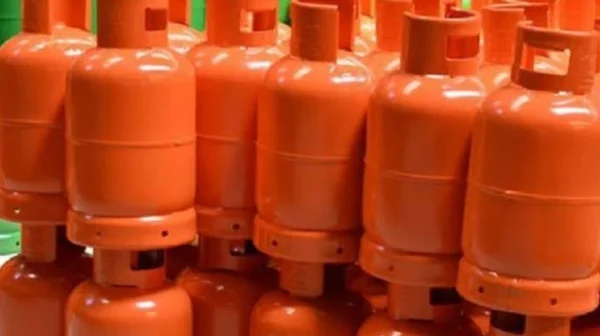
Domestic producers of Liquefied Petroleum Gas, popularly known as cooking gas, exported thousands of metric tonnes of the product and its derivatives between January and May 2026 despite rising prices and supply shortages in Nigeria, a presentation by the Nigerian Midstream and Downstream Petroleum Regulatory Authority has revealed.
Data presented by the Authority Chief Executive of the NMDPRA, Mr Rabiu Umar, at the “Gas Emergency Meeting with Stakeholders on Rising Prices of LPG” showed that local production significantly exceeded domestic supply during the period, with the excess volumes exported as either LPG or propane.
The document, analysed by our correspondent on Sunday, showed that Nigeria produced 5,190 metric tonnes of LPG per day in January but supplied only 5,115MT to the domestic market, leaving a balance of 75.73MT.
In February, production rose sharply to 6,451MT per day, while domestic supply fell to 4,084MT, leaving an exportable balance of 2,367.17MT. Similarly, in March, producers recorded an excess of 1,610.36MT daily; 2,517.32MT in April; and 1,383.97MT in May.

An analysis of the figures showed that a cumulative 7,954.55 metric tonnes per day represented volumes exported as LPG or propane over the five-month period.
The findings emerged amid growing concerns over the continuous increase in cooking gas prices despite Nigeria’s huge gas reserves and rising domestic production.

The NMDPRA presentation further revealed that while local supply has improved in recent years, it still falls short of national demand. According to the regulator, the country’s annual LPG requirement stands at 1.42 million metric tonnes, while total supply remains below the benchmark.
The report stated that Nigeria supplied 565,106 metric tonnes of LPG between January and June 18, 2026, against a benchmark requirement of 657,072 metric tonnes, resulting in a supply deficit of 91,966 metric tonnes.

The authority also noted that coverage of domestic demand improved from 78.7 per cent in 2024 to 88.4 per cent in 2025, then declined to 86 per cent in the first half of 2026.
The document reads, “Coverage improved from 78.7 per cent in 2024 to 88.4 per cent in 2025 but eased to 86.0 per cent in 2026 year-to-date. Daily requirement is estimated at 3,888 metric tonnes, while annual requirement stands at 1,419,249 metric tonnes. Local supply remained dominant, contributing 82.4 per cent of total supply in 2025 and 88.2 per cent in 2026 year-to-date.”
The report also showed that domestic production is increasingly being driven by local producers. Nigeria LNG Limited remained the largest producer during the review period, accounting for 29.01 per cent of total LPG production.
It was followed by Chevron Nigeria Limited with 22.93 per cent, Dangote Petroleum Refinery and Petrochemicals with 16.26 per cent, and Seplat Energy Producing Nigeria Unlimited with 13.63 per cent. Others include Ardova’s AHL with 6.85 per cent, Odum Gas Processing Plant with 6.13 per cent, and OVADE Gas Processing Plant with 3.53 per cent.
However, the presentation showed that while most producers supplied their LPG volumes to the domestic market, some exported propane, while one producer exported all its LPG output. The document revealed that Nigeria LNG supplied 187,559 metric tonnes to the local market while exporting 204,761 metric tonnes of propane.
Dangote Refinery supplied 105,127MT locally and exported 104,388MT of propane. Similarly, AHL supplied 44,293MT domestically and exported 43,700MT of propane, while SEPNU supplied 88,121MT and exported 89,156MT of propane.
Most strikingly, Chevron, which produced 148,222 metric tonnes during the period, exported all its LPG output and supplied nothing to the domestic market. The presentation specifically stated: “Chevron – 148,222MT; domestic supply: zero; export: 100 per cent. All LPG is exported.”
Stakeholders have repeatedly blamed rising cooking gas prices on inadequate domestic supply, foreign exchange pressures, and growing dependence on imports.
The latest figures, however, suggest that despite improvements in local production, Nigeria still faces significant supply gaps, forcing the market to rely partly on imports to meet domestic demand.
The NMDPRA data also showed that local sources accounted for 88.2 per cent of total supply in 2026, up from 82.4 per cent in 2025, underscoring the increasing importance of domestic producers in meeting Nigeria’s cooking gas needs.
The surge in cooking gas prices threatens the Federal Government’s clean energy transition programme and could reverse gains recorded in the adoption of LPG as a cleaner household fuel.
Nigeria possesses more than 200 trillion cubic feet of proven gas reserves, one of the largest in Africa, and the Federal Government has designated gas as the country’s transition fuel.
However, persistent supply shortages, infrastructure gaps, and export commitments have continued to limit the availability of affordable cooking gas for millions of Nigerians.
To resolve the situation, marketers of Liquefied Petroleum Gas (cooking gas) imported 16,642.66 metric tonnes of Liquefied Petroleum Gas within the first 19 days of June as part of efforts to bridge domestic supply shortages and ease pressure on consumers facing rising prices.
The imported volumes came amid concerns that local supply has remained insufficient to meet growing domestic demand, forcing marketers to increasingly turn to foreign sources.
In recent weeks, retailers and consumers have reported difficulties accessing supplies, while prices have continued to rise. Aside from the rising cost of cooking gas, Nigerians said the product was also unavailable at retail outlets, forcing many to resort to charcoal and firewood for cooking.
The authority noted that consumers across the country were paying far above the regulator’s indicative pricing benchmarks due to marketer profiteering and distribution bottlenecks.