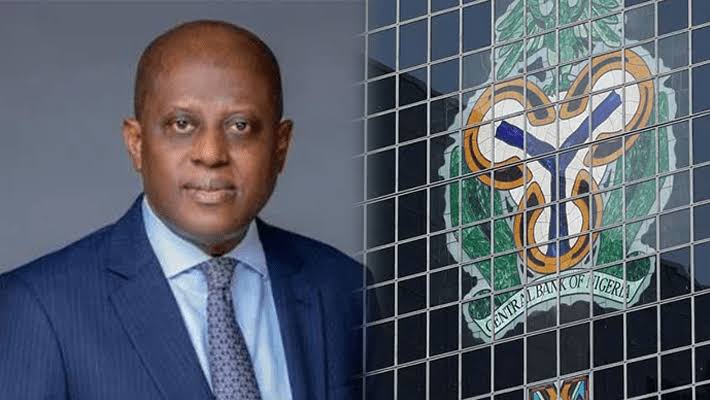

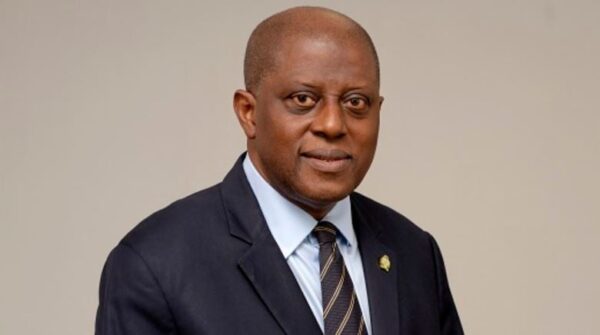
The Governor of the Central Bank of Nigeria, Olayemi Cardoso, has said that Nigeria is developing a new framework to enable the use of national currencies in bilateral trade settlements.
Speaking at a press briefing at the IMF/World Bank Annual Meetings in Washington DC, Cardoso explained that while the country had previously experimented with local currency trade agreements, the initiative did not yield the desired results.
“We have had an experiment with that (switching to national currencies in bilateral trade). And to be frank, it did not work out very well for us.
That is not to say that we are not interested in doing this. We are. And we are really at an elementary stage of putting up a framework, now that our currency is more competitive, to be able to ensure that it is a win‑win for everybody.”

He said the Central Bank was taking a more cautious and structured approach this time to ensure that future local currency trade arrangements deliver mutual benefits and reduce dependence on foreign exchange in cross-border transactions.
Bilateral currency trade arrangements, also known as local currency settlement agreements, allow two countries to trade directly using their national currencies instead of the U.S. dollar or other reserve currencies.

Nigeria has experimented with bilateral currency deals before, most notably with China, through the 2018 currency swap agreement signed between the Central Bank of Nigeria and the People’s Bank of China.

The deal, worth about N720bn (or RMB 15bn), was designed to ease pressure on Nigeria’s dollar reserves, promote trade with China, and make it easier for Nigerian importers to access yuan for Chinese goods.

However, the arrangement struggled to gain traction due to limited awareness among traders, logistical bottlenecks, exchange rate uncertainty, and the lack of a robust settlement framework. Many Nigerian businesses continued to rely on the U.S. dollar for imports, while local banks struggled to build sufficient yuan liquidity.
CBN officials later acknowledged that the pilot phase “did not work as efficiently as expected,” though it provided lessons for designing more effective future frameworks.
Despite this, a new bilateral currency swap agreement was agreed in December 2024 between Nigeria and China.
The renewed deal, jointly announced by the CBN and the People’s Bank of China, amounts to N3.28 tn, approximately 15 billion yuan or $2.09 bn.
Valid for three years and renewable upon mutual agreement, the swap deal aims to boost financial collaboration, simplify transactions involving the naira and yuan, and reduce reliance on the U.S. dollar in trade.
Cardoso’s comments suggest that the Central Bank is revisiting the idea of settling bilateral trade in national currencies, especially as the naira becomes more competitive following recent foreign exchange reforms.
The governor also stated that the country’s foreign exchange reforms and macroeconomic adjustments have strengthened its external position, resulting in a positive balance of trade for the first time in years.
The CBN chief said ongoing economic reforms had boosted investor confidence and improved Nigeria’s trade position, noting that a more flexible exchange rate was already encouraging local production and discouraging imports.
“From Nigeria’s perspective, it is less of a problem for us because a lot of the things that needed to have been done, we did much earlier,” he explained. “We now have a more competitive currency, and as a result, for once, we have a situation where we have a positive balance of trade, a trade surplus expected to be around six per cent of GDP and to remain at that for some time.”
He said the development reflected a “complete restructuring” of the economy that had built resilience and created buffers against external shocks, particularly in the oil sector, the country’s major export earner.
Cardoso, who serves as First Vice-Chair of the G24, said developing and emerging economies were now more effectively represented in global financial discussions, especially under the Bretton Woods institutions, the International Monetary Fund and the World Bank.
“It has been very useful, and it is clear to me that under the leadership of Argentina, being the Chair of the G24, we have certainly advanced the cause with the voice of the emerging economies,” he said.
“We have been able to get a more effective seat at the table, especially with respect to the Bretton Woods Institutions and getting our voices heard. That, in itself, is a major step forward. We expect that the very good work that has been done will be further deepened in the years ahead.”
Cardoso also noted that Nigeria’s economic progress was the outcome of early and decisive policy actions that shielded the economy from deeper shocks and restored confidence in the local currency.
The G24, established in 1971, coordinates the positions of developing countries on international monetary and development finance issues.